
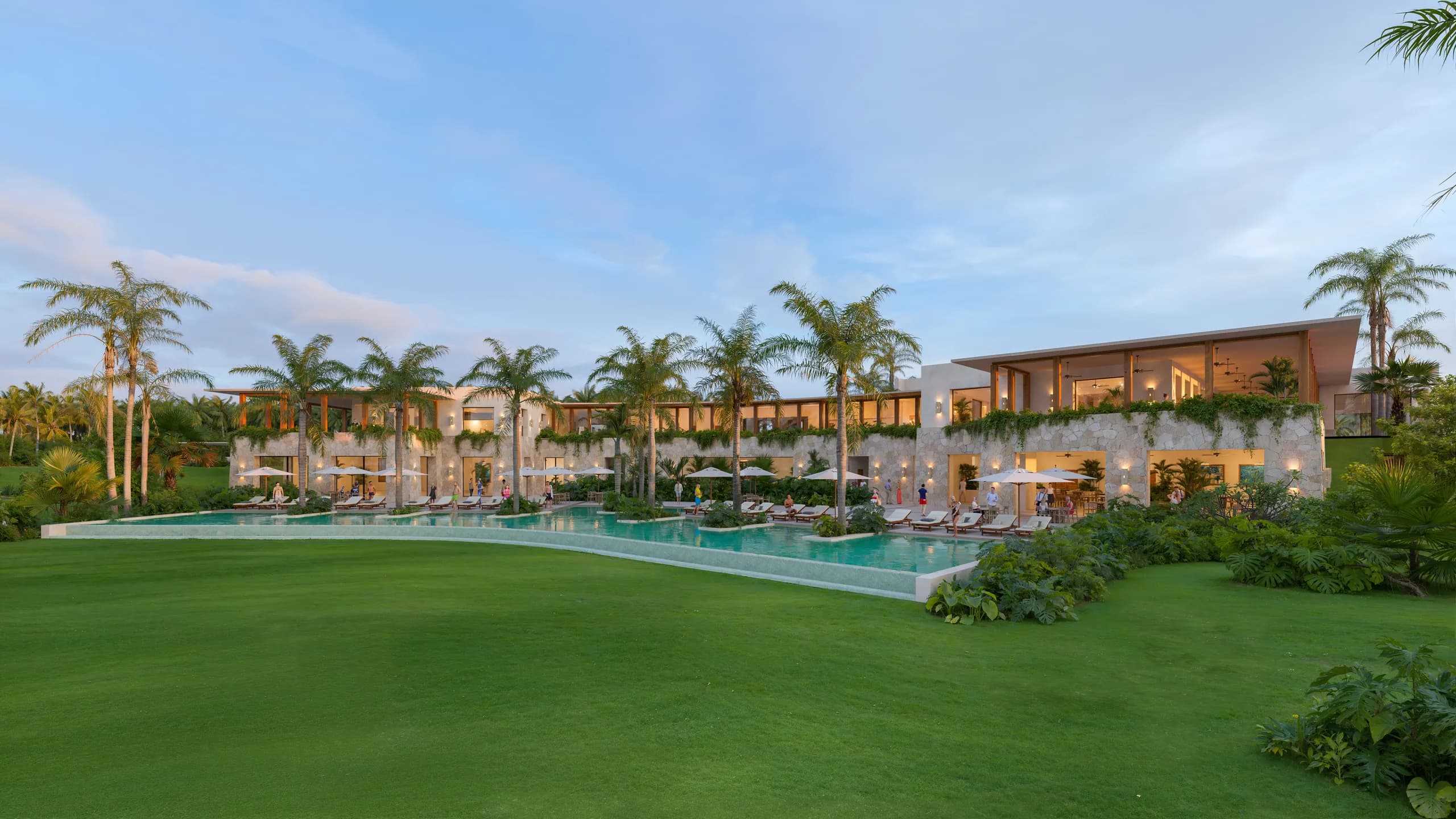
Il y a une différence entre avoir de l’eau à proximité et vivre face à l’eau. La première est une proximité géographique. La seconde est une relation quotidienne qui change la manière dont la journée commence, dont le temps se perçoit et dont les personnes qui partagent cet espace se relient les unes aux autres. Le Lake Club de Country Lakes est conçu pour la seconde.
EDSA et la philosophie de l’eau comme écosystème
EDSA — le cabinet de master planning et d’architecture paysagère fondé en 1960, avec des bureaux à New York, Baltimore et Shanghai — conçoit depuis des décennies la relation entre les communautés résidentielles et les plans d’eau. Sa conviction est que l’eau ne doit pas être une décoration : elle doit faire partie du système écologique et social du lieu.
À Country Lakes, cela se traduit par plus de 50 hectares de plans d’eau qui ne sont pas des bassins ornementaux — ce sont des écosystèmes vivants avec des cycles de nutriments, une végétation riveraine, une faune aquatique et une gestion de la qualité de l’eau qui assure sa transparence et sa santé au fil des années. Le Lake Club s’implante au point de plus grande ouverture visuelle de tout ce système.
Le programme du Lake Club
Le Lake Club comprend :
- Une terrasse principale sur le lac — le point de rencontre au coucher du soleil
- Un ponton privé en guise de belvédère sur le lac
- Un lounge palapa avec bar et espace de restauration
- Une zone de hamacs et de transats face à l’eau
- Des espaces de repos et de contemplation au bord de l’eau
- Une salle d’événements avec terrasse sur le lac pour les célébrations privées
Le lac comme régulateur du microclimat
L’un des avantages les moins visibles mais les plus réels de vivre au bord d’un grand plan d’eau est son effet sur la température. Les plus de 50 hectares d’eau de Country Lakes agissent comme une masse thermique : ils absorbent la chaleur durant la journée et la libèrent la nuit, modérant les extrêmes de température. Dans le contexte des tropiques yucatèques, cela se traduit par une différence perceptible de 2 à 4 degrés Celsius par rapport à la moyenne urbaine de Mérida.
« L’eau n’est pas seulement ce que l’on voit — c’est ce que l’on ressent dans l’air, dans la lumière du couchant sur la surface, dans le son qu’a le lieu à six heures du matin. »